
There are many communication channels we use day to day, so abiding to a consistent written voice is crucial in ensuring a singular and intentional brand perspective. Resource this page to have a clear understanding of how we perceive ourselves so it can be interpreted in all forms of communication we create.
Voice
We are an innovation company and although our foundation is tech, our core is weather which is inherently human. And because that we lead with with a relatable human voice. Speaking and writing human-to-human allows us to resonate with an audience whose objectives vary greatly. After all, a conversation can propel the world.
Tone
The Weather Company’s tone must instill confidence, drive decisions and propel the world. To achieve this, use language that is:
Empathetic
- Be relevant and aware
- Flex with the temperature
- Instill confidence, not fear
Intelligent
- Smart, but not over anyone’s head
- Pithy, not fluffy
- Packed with expertise, not jargon
Catalytic
- Active and bold, not passive
- Inspiring, enlightening, not preachy
- Inclusive
Archetype
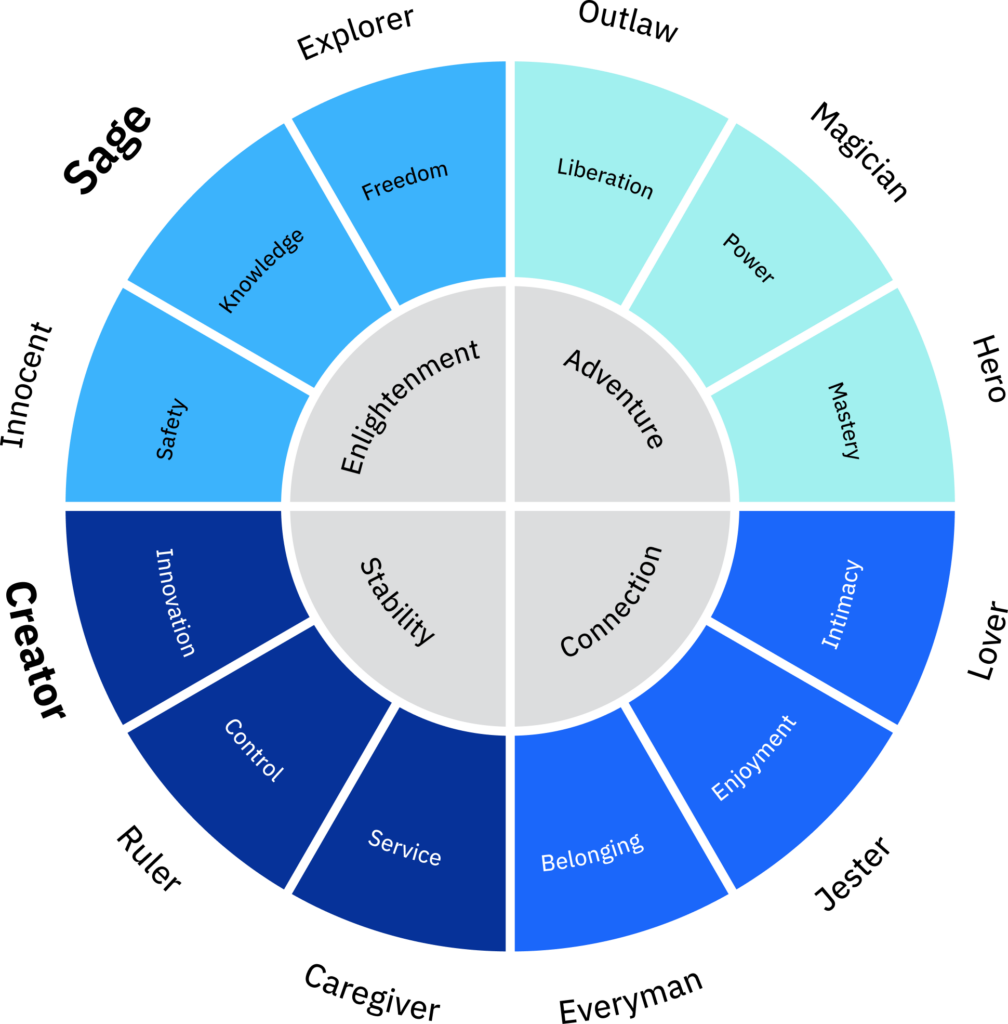
Our brand needs to connect with our audiences in a deep and meaningful way in order to build authenticity, loyalty and trust. A brand archetype provides a framework based on human psychology to help build a worthwhile and valuable relationship.
In the 1940s, Swiss psychologist Carl Jung developed a set of common personality archetypes. Jung believed these were innate and hereditary, representing a model image of a person that transcends language, culture and time. As individuals, we can all inherently recognize and relate to the archetypes. They play a role in influencing our behavior on a subconscious level, leading to typical behavioral patterns, desires, values and motivations all driven by a single dominant goal.
Brand archetypes are derived from Jung’s original set and consist of 12 traits:
We are the Sage/Creator. A constant innovator. A trusted ally who propels our partners be the hero – the hero of their industry, the hero of their story – by helping them harness the power of weather to make better decisions.
Usage Dos and Don’ts
Weather Means Business
Is a trademarked phrase of The Weather Company and an important element of our brand voice. We ask that when using it you keep all punctuation, capitalization, and phrasing consistent with what is shown here.
Do:
Weather Means Business (As a headline)
Weather means business. (In a sentence)
Don’t:
Weather. Means. Business.
Weather Means Business!
Weather… Means Business
Refer to the below for use in a lockup. These files were created for placement as art, but can easily be replicated using our Plex font and the brand palette.


Inline 2-line:
The preferred treatment to keep the tagline the most prominent.
Stacked:
To be used in confining or 1:1 aspect ratio or vertical spaces.
Inline 3-line:
To be used in less confining spaces for sizing concerns and when we want the tagline to be more prominent.
Download “Weather Means Business” files from Drive Folder


Weather: The Original Influencer
Is a trademarked phrase of The Weather Company and an important element of our brand voice. We ask that when using it you keep all punctuation, capitalization, and phrasing consistent with what is shown here.
Do:
Weather: The Original Influencer. (As a headline)
Weather is the original influencer. (In a sentence)
Don’t:
Weather. The Original Influencer.
Weather – The Original Influencer
Weather, the original influencer!
Weather… The Original Influencer.
Avoid references to weather’s “unpredictability,” “climate change,” and “doom and gloom” scenarios.
Do:
Weather is becoming more volatile and extreme.
As our climate evolves, weather’s impact on consumers and businesses is intensifying.
The amount of major weather events is growing.
Don’t:
Use the acronyms “TWC”, “TWCh”, or “TWCo” externally
The “Why” Behind the Rule: No “TWC“, “TWCh“, or “TWCo” Externally
While “TWC”, “TWCh”, or “TWCo” is a convenient shorthand internally for employees, it dilutes the brand when used facing the public. Here is why we strictly enforce the full name:
- We Own the Category: The word “Weather” is our middle name—literally. It is our primary value proposition. Reducing the name to an acronym strips away the very thing we are famous for. “The Weather Channel” immediately tells the consumer what they are getting; “TWC” is an empty vessel that requires context to understand.
- The “Time Warner” Problem: For decades, “TWC” was the primary ticker and abbreviation for Time Warner Cable (now part of Charter/Spectrum). Using the acronym externally risks confusing our audience with a telecommunications provider. We want our audience thinking about storms and sunshine, not their internet bill.
- Search and Discoverability: In an era of SEO and voice assistants, clarity is king. Users ask Alexa for “The Weather,” not “TWC.” Reinforcing the full name ensures we remain the authority in natural language search.
- Authority vs. Jargon: Acronyms often feel like corporate jargon or “inside baseball.” The full name, “The Weather Channel,” carries a legacy of trust, authority, and safety that three letters simply cannot convey.
Don’t:
Weather is becoming more unpredictable.
Climate change is intensifying weather’s impact on consumers and businesses.
The amount of destruction and death caused by weather is growing.
Do:
Use of The Weather Channel and weather.com trademark (USA only. Check for approval for use in other countries.) - The Weather Channel brand should always accompany any mention of weather.com (e.g., The Weather Channel® on weather.com). The weather.com name should always appear in lowercase, even when used at the beginning of a sentence. It is recommended not to include www. when using the weather.com name.
- Additionally, both names should appear in itAvacs or bold every time they are used in text. The Weather Channel name is protected in its entirety, including the word “The.” You should never say “Weather Channel” without “The” in front of it.
- The weather.com name is protected in its entirety as well.
- The possessive form of The Weather Channel or weather.com should never be used.
- Trademarks are adjectives, not nouns. They must never be used as the “generic name” of the service.
You must use the generic name of the service to which the trademark applies at least 1x in any written communication. For example, we have frequently used the word “App,” “network,” and “brand”
after The Weather Channel.